Context Intelligence for On-Device Vision Systems.
Understand what's happening. Make smarter decisions. Protect privacy — without ever uploading an image.
Cameras see pixels.
Ours understands meaning.
Traditional AI moderation has no model of what is actually happening. It sees shapes. It triggers on patterns. It cannot tell a medical exam from a violation. Context intelligence changes that.
See why this matters →pixels[1920×1080] → skin_detected
// what PurenetX understands
scene: clinical_setting
intent: professional
consent: established
decision: context_aware
Two Ways to Process a Camera Frame
One looks at pixels. One understands what's happening. The outcome — and the user experience — are completely different.
→ pixel_scan(frame)
→ skin_detected = true
→ decision = BLOCK
// No scene understanding
// No intent. No context.
→ scene = understand_context(frame)
→ intent = assess_intent(scene)
→ risk = score_risk(scene, intent)
→ decision = policy_decision(risk)
Same Scene. Completely Different Decisions.
Five real scenarios. See exactly what breaks without context — and what becomes possible with it.
Same physical content. Different understanding. Better outcomes for everyone. Full explainer →
What We Have Today
Our framework is designed and an early on-device prototype is working. Model training on partner data begins after our first funding round (target 2027). We're seeking design and research partners for co-development and validation.
Context Intelligence Framework
Six-dimension analysis framework (scene · activity · relationship · intent & consent · vulnerability · risk signals), built on our 50-scenario research database.
On-Device Model
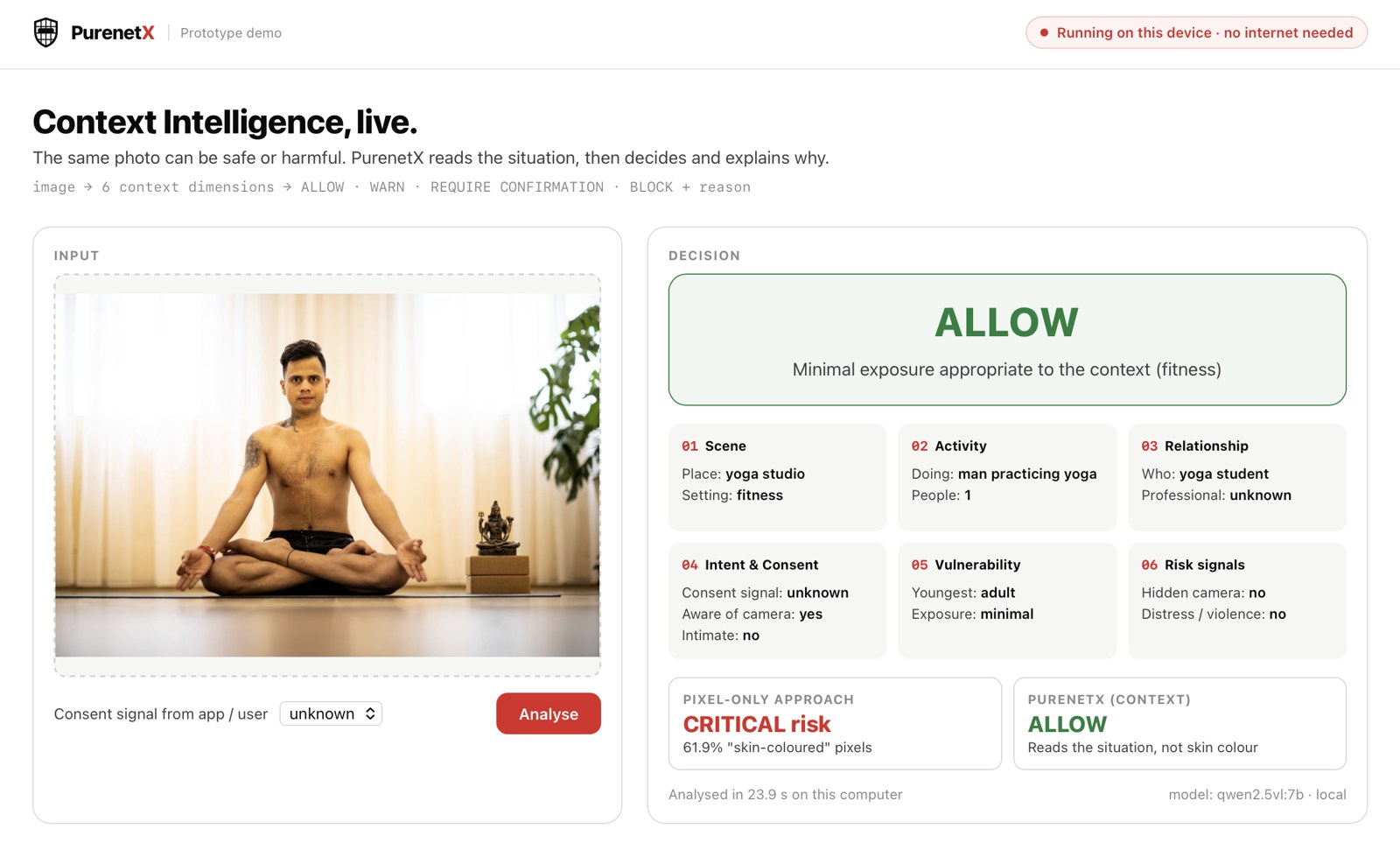
Early on-device prototype working (image → context → explained decision). Testing in progress.
SDK
SDK (a software kit apps and devices can build in) in development. Once recruited, design partners will be able to begin data collection while the model develops in parallel.
Context Knowledge Base
Our labelled scenario database: 50 research-annotated scenarios across medical, fitness, celebration, intimate, and safety contexts. Available to research partners under NDA. About the database →
Design & Research Partners
Design partners (camera apps, platforms, robotics) for pilot validation — and research partners (universities, institutes) for co-authored publications.
Think you're a fit?
We're recruiting for co-development of the on-device model (2027) and pilot partnerships. Pilot length agreed with each partner. We review applications weekly.
Get in touch →Four Principles. No Exceptions.
On-Device Processing
No cloud required. No data transmission. Privacy by architecture, not policy.
Transparent Reasoning
We show you why we made each decision. Explainability is not optional.
Research-First
Built on peer-reviewed principles. We validate before we publish numbers.
Honest About Stage
We're early. We say so. Transparency builds better partnerships than hype.

Security research taught me how systems get exploited. I built PurenetX to close the most consequential gap — harmful visual content captured before anyone can stop it. The answer isn't better moderation. Our goal is earlier interception, with full context.
Early prototype working. Now building the real thing.
✓ Architecture designed for on-device, privacy-first processing
✓ Early on-device prototype working (image → context → explained decision)
→ Production deployment: after pilots (2027–2028)
105 photos never used in development, labels written first, engine frozen, one run. 88 of 105 correct (84%). 49 of 55 safe photos left alone (6 false alarms); 26 of 35 harmful photos flagged (9 missed).
Main weakness: telling whether people behind windows know they are being seen. Child-safety rules tested only on policy and text cases, never on real child images.
On 63 everyday photos, a skin-colour approach wrongly flagged 27 as high-risk. Our context engine (earlier prototype version) flagged none, running entirely on a laptop with no cloud.
63 safe everyday photos (stock + our own phone photos), each labelled by us before testing. Compared against our earlier skin-colour prototype. This measures false alarms on safe photos only.
That's why we're recruiting design partners and researchers to build this with us — not to deploy a finished product.
From Framework to Production
Model Development & Research
Enterprise Pilots & Publication
Broader Integration
See How It Works (Prototype Demo)
Our working prototype shows the framework and decision logic in action. Model training on partner data begins after our first funding round (target 2027). We review applications weekly — if your use case is a strong fit, you'll hear from us within 2 weeks.